Showing posts with label reading. Show all posts

Sunday, August 19, 2018

a bit of an eBook rant

I like eBooks. My library has eBooks & eAudiobooks (BorrowBox, cloudLibrary, Wheelers, RB Digital). Aside from the sheer convenience (yes, I'm a very impatient reader so when I want to read something I want to read it now & not have to wait for the library to open), because I borrow them from the library they're free ... like everything else I borrow from the library. That's how libraries work.

A key role that libraries play is to introduce readers to authors, to introduce readers to stories, to introduce readers to reading. Libraries pay exactly the same dollar amount to buy an ebook as they would to buy and print book. In fact libraries generally get a better deal on the print book because book suppliers provide anything from 10-30% discount depending on how much you buy. This is something ebook vendors don't do. Yes, they set up platform deals to get libraries to buy the product & the first purchase is usually discounted - because this is part of the hook. But the actual purchase price of an ebook is the same as a physical book.

So when publishers like Tor/Forge ...

Tor Books is the most successful science fiction and fantasy publisher in the world. Winner of the Locus Award for best SF publisher 20 years in a row, Tor regularly puts books like Robert Jordan’s Knife of Dreams and Terry Goodkind’s Chainfire atop national bestseller lists. Tor’s Orb imprint offers trade paperback editions of outstanding, award-winning SF and fantasy backlist titles. Additionally, the Tor Kids program includes Starscape, Tor Teen, and one of the largest classics lines in North America.

The Forge imprint publishes a wide range of fiction, including a strong line of historical novels and thrillers, plus mysteries, women’s fiction, and a variety of nonfiction titles. Tor/Forge has also become the leading modern publisher of American westerns.

Well-known authors recently published by Tor and Forge include Andrew M. Greeley, Douglas Preston, Orson Scott Card, Michael & Kathleen O’Neal Gear, Harold Robbins, Susan Kearney, Jonathan Carroll, Brian Herbert, Kevin J. Anderson, Andre Norton, Terry Goodkind, Robert Jordan, former Secretary of Defense William B. Cohen, Susanna Clarke, Allan Folsom, Eric Lustbader, Elizabeth Haydon, Gene Wolfe, Morgan Llewelyn, David Lubar, David Weber, Christopher Pike, and Philip K. Dick.

... decides to put a 4 month embargo on libraries buying their ebooks I'm sitting up and taking notice.

This is the statement from Tor:

Tor Books, a division of Macmillan Publishers and a leading global publisher of science fiction and fantasy will be changing our eBook lending model to libraries as part of a test program to determine the impact of eLending on retail sales. Our current analysis on eLending indicates it is having a direct and adverse impact on retail eBook sales.

Effective with July 2018 publications, all new titles from Tor Books will become available for library eBook distribution four months after their retail on-sale date rather than the current program which allows libraries to purchase the titles on their retail on-sale date. During the test period, we will work closely with our library vendors who service this channel to evaluate the results and develop ongoing terms that will best support Tor’s authors, their agents, and Tor’s channel partners.

In addition, Macmillan will actively participate in the recently launched “Panorama Project,” the first large-scale, data-driven research project focused on understanding the impact of library holdings on book discovery, author brand development, and retail sales (panoramaproject.org).

With data from both programs, we will be in a better position to analyze and understand the impact of eLending on our publishing program. The timing of the test period is open-ended.

Already there have been a few articles on this subject: you can read Sari Feldman and Nate Hoffelder  just for starters. Sari Feldman provides context on how the American Library Association has both dropped the ball and can pick it up again (she also refers to this earlier article from Andrew Albanese that is also worth a read), while Nate Hoffelder looks more at the impact on OverDrive users and touches on the context of publishers and ebooks in general. They give an excellent overview of the issue not to mention raising a series of questions for libraries and for readers.

Is this an issue just for OverDrive libraries? I am yet to have seen any impact of this on purchasing titles through my library's current platforms (none of which are OverDrive), but then we generally buy quarterly depending on available funds so it may be that our buying pattern isn't affected by this quite so much. We're certainly cognisant of the typical publisher constraints on number of loans / 2 year period of purchase before we have to re-buy a book (for whatever reason publishers simply do not accept that libraries could possibly have books on their shelves for more than 2 years without the need to replace them, trust me there re books on my shelves that have been there for 10 years and continue to be used). The problem with this is that every purchase needs to be valid - if we buy a print book and it doesn't get loaned in 2 years we might move it to another branch before we consider removing it altogether. If an eBook doesn't get borrowed in 2 years I'm not replacing it so the publisher has already lost out on that 2nd potential purchase. And yes, if any title (physical / digital) is heavily used (ie, in ebook parlance exceeds 26 loans within that 2 year period)  the library will most likely replace it - funds allowing.

What is it about ebooks and libraries that scares publishers so much? How are ebooks any different to print books? Publishers want people to buy their books and libraries are pretty much a captive sale in that regard, often buying multiple copies of a title that we know will be popular. We expose our members to authors and titles and series and genres that they may have never read before and often hook them in - to the point where that reader will go out and buy their own physical copy. So libraries help publishers by providing the opportunity for readers to decide to buy for themselves. Without libraries publishers would not make as many sales as they do. I'd be wary of biting the hand that feeds you.

Back in 2012 Tor made a big statement ensuring their ebook titles be DRM-free. Followed up two years later by this presentation from Tom Doherty at the Book Expo of America on the impact this move had on sales (hint: none, if anything sales had improved). In 2012 Tor also announced they had set up an ebook store to sell the full range of Tor ebook titles DRM-free. A key aspect of this ebook store was to also provide access to free ebooks. The underlying reason behind this was to tease readers by giving them free access to an early publication from an author which would then hook them into buying the rest of the series. It exposed authors to readers who might never have read them otherwise (kind of what libraries do). Tor.com (a site dedicated to science fiction, fantasy, and all aspects of SF/F fandom; [publishing] original fiction and art as well as reviews and commentary on books, stories, movies, comics, and related topics. Tor.com is publisher neutral, and we operate in our own special corner of Macmillan, the publishing company that also encompasses Tor Books) continues to provide access to 'Free eBooks'.

What about the readers? When all is said and done and the dust settles none of this is possible without authors and readers. Authors obviously want to write and to keep on writing. Publishers help them get their writing out there. But it is the readers who are the market. Readers are the ones who need to be enticed to part with hard-earned cash to buy a thing - whether it's print or digital. Interestingly enough, in Australia the bulk of the ebook platforms that public libraries can provide their members with access to do not include platforms suitable for kindle users. Sure, if you've got a kindle fire you'll be right. But in basic terms less Australian libraries have OverDrive than the other platforms. So if any of our library members want to use their kindle they must use Amazon. With the emergence of these alternative platforms (BorrowBox, cloudLibrary, Wheelers, RB Digital) there is less reliance on dedicated ebook readers and more development of apps for phones and tablets. I don't need a kindle to read an ebook or listen to an eAudiobook, I can use my phone. And I do.

Readers influence their library's purchasing habits. Libraries constantly accept suggestions from their members to buy a particular title and this goes as much for ebooks as for print. Indeed one of the neatest features of an eBook app is the facility to be able to suggest that my library buys titles that are in the list of available titles but not actually purchased by my library. This can often influence libraries further to buy physical copies as well. It is due to this feature that my library now has an expanded eBook collection of Jack Campbell's excellent Sci-Fi series. As a reader I stumbled across an author in a genre I read occasionally and liked it so much I suggested my library go out and buy another 10 books just so I could finish reading The Lost Fleet and The Lost Fleet: Beyond the Frontier series. I don't usually go in for big space battles described with naval precision but these I enjoyed immensely. But I never would have discovered them if my library did not first tease me with an ebook. If I, as a reader recently enamored of a new author, suggest a title to my library to add to their ebook collection but because it's a newly published Tor/Forge title and under a 4 month embargo because it's a library that wants to buy it then I am hampered, as a reader, by the very publisher of the author I want to read. I fail to see how this helps me as a reader, helps the author as the writer, helps the publisher at all.

It will be interesting to see how the ALA steps up to this challenge from Tor and Macmillan. It will be interesting to see how and when ALIA steps into the ring here in Australia. ALIA certainly regards libraries as part of the book industry and it's way beyond time that publishers took that on board. Libraries are not the enemy. It will be interesting to read the outcome of Macmillan's "Panorama Project".

Saturday, January 2, 2016

A year of reading - 2015

I like tracking what I've read and of course Goodreads is perfect for this.

Apparently in 2015 I read 67 books with a total of 21,475 pages - go figure.


Thursday, January 2, 2014

2014 Australian Women Writers Challenge


A new year brings a new reading challenge.
As well as #rwpchat and the ubiquitous GoodReads challenge, this year I've decided to participate in the Australian Women Writers Challenge.

For me the challenge will be in developing my review writing skills. I've done a little bit of reviewing for ALIA's inCite magazine a few years ago but mostly keep my personal reviews to GoodReads or this blog. (Let's be honest, mostly I just rate a book on GoodReads and leave it at that, call me lazy). Which is why I'm excited about #aww2014. It's a challenge that not only stretches me as a reader and reviewer but more importantly highlights the work of Australian women writers.
And if there's one thing which I am passionate about as a reader, it is supporting Australian writers.

So I've joined the AWW challenge group on GoodReads and I'll be signing up and focusing my reading efforts (and reviewing efforts) on the work of Australian women. I am still debating what level to aim for (Stella = 4; Miles = 6; Franklin = 10) but am really looking forward to sharing my reviews and reading the reviews of other readers participating in #aww2014.

This is going to be fun!


Tuesday, August 6, 2013

Ramblings....

Back towards the end of July I came across an article written by Kerry Parnell listing the 25 books you really don't have to read before you die

The books listed include:

  • Eucalyptus / Murray Bail
  • Ulysses / James Joyce
  • Cloudstreet / Tim Winton
  • The Dice Man / Luke Rhineheart
  • Catch 22 / Joseph Heller
  • To The Lighthouse / Virginia Woolf
  • The Slap / Christos Tsiolkas
  • Twilight / Stephanie Meyer
  • On The Road / Jack Kerouac
  • The Metamorphosis / Franz Kafka
  • Midnight's Children / Salman Rushdie
  • Oscar & Lucinda / Peter Carey
  • My Sister's Keeper / Jodi Picoult
  • Sons and Lovers / D H Lawrence
  • We Need To Talk About Kevin / Lionel Shriver
  • 50 Shades of Grey / E L James
  • Crime and Punishment / Fyodor Dostoyevsky
  • Eat, Pray, Love / Elizabeth Gilbert
  • Shantaram / Gregory David Roberts
  • Tess of the D'Urbervilles / Thomas Hardy
  • Charlie and The Great Glass Elevator / Roald Dahl
  • Memoirs of a Geisha / Arthur Golden
  • The Devil Wears Prada / Lauren Weisberger
  • The Secret / Rhonda Byrne
  • The Celestine Prophecy / James Redfield


There's a comment from Grant of Melbourne right at the end that neatly sums up a lot about how I feel about this article....

I [am] so glad that we have someone like this reviewing books who is clearly more intelligent than the multitudes who have enjoyed these books or the people who as a group have reviewed the books and deemed them worthy [of] recognition. Sorry Kerry but many of us have progressed beyond the Cat in the Hat and Green Eggs and Ham, have laid down the crayons from our colouring books and can follow stories that have multiple threads, moral dilemma, convolutions or the other issues that seem to plague you with these books. The reason that people enjoy them or that they are deemed classics is that they reflect in many regards our lives. You inability to connect to this either indicates a bland life or some other disconnection with the world around you... rather sad either way,

Moving on.

There are various ways of looking at this list - one is to take the list at face value and consider the merits (or not) of each title, another is to consider the act of list making itself (after all who am I or anyone else to tell others what to read and what not to? I honestly dislike lists that state "100 books to read before you die", or "100 places to visit before you die", and so on - seriously, a slow reading year for me is roughly 100 books, does this mean my death is imminent?). 

I guess the chief part of this article that I truly take umbrage to, before I even get to the books listed are the words .... "I'd like to relieve you of some literary pressure and reveal the titles life's just far too short to waste time on". Since when is life too short to read whatever takes your fancy? Since when is life too short to read what has won an award? Since when is life too short to read outside your comfort zone and push the boundaries of what reading (and indeed writing) is?

I personally have no intention of reading beyond Twilight or 50 Shades of Grey - I've read both those titles and have no inclination to read the remainder of either series. Whilst I consider both books to have some literary flaws I also see great merit in both. I will continue to hold up 50 Shades as an example of writing that has got locale descriptions down perfectly - R L James certainly knows how to describe a room, what people look like, what they are wearing. The rest of the book didn't do a lot for me personally but I do recognise and accept the appeal to others. Aside from what I think, both books got people reading and the bottom line is that it's all about "bums on seats".

I have read Ulysses by James Joyce. It's not an easy read but I do believe it's worth it. Reading Ulysses forced me to reconsider the experience of reading and to be challenged to accept that a story can be told in oh so many ways - all within the one novel. I am also a serious fan of train-of-thought (as anyone who knows me well will attest) so the ending pages were an absolute delight where lack of punctuation fought hard against the flow of words - I loved it!

I personally cannot stand Thomas Hardy, but I put a lot of that down to a bad experience reading Tess of the D'Urbervilles during high school. Being forced to read a book and choosing to read one can really influence how you go on to feel about that book and this one is certainly a case in point. Here I was frustrated by the number of pages Hardy spent describing the heath yet leaving me simply with a feeling that it was low and a green-purplish colour.... But, I am an impatient reader - I want to know now what is happening and certainly as a 17 year old I had no patience at all for the casual meanderings that established the scenery. Now I see the cleverness, now I see the beauty in the prose, now I see the clever use of language, now I see that the pages were worth it .... I'm still an impatient reader but I'm a lot more forgiving these days.

I could discuss each and every title on this list but it will only and always be my own opinion, to which you are very welcome to disagree. There is no definitive list, there will never be any agreement. Disparity is as natural as agreement. I adore Shakespeare. I like dark vibrant colours. I prefer Fantasy fiction over World fiction. I am me. You are you. And to be blunt, thank goodness for that for if we were all the same it would be a jolly boring world we live in!

I remain however, vehemently opposed to anyone who tells me that I shouldn't waste my time on a particular book. After all, it's my time to do with as I please. Reading is a personal experience and one which should be respected. I don't think there can ever be a list which definitively gathers those books which are worthy of reading and those which are not. You need only look at any title listed on GoodReads to see the sheer variance in rating and opinion for each and every title there. And I for one think that the difference of opinion is what adds to the discussion and to the value of each reading experience.


Oh and by the way, I've only not read 6 out of the 25 books listed ... 


Saturday, July 28, 2012

What is reading?

For 2012 the National Year of Reading twitter reading group set up a blog - love2read2012 - to act as a point of reference and maintain the conversation. One of the pages on that blog discussed what is reading. In 2013 the team is continuing the twitter reading group (which began with the #readit2011 campaign), spreading globally and expanding on the idea of what reading is. The new blog is called ReadWatchPlay and was launched at the Imagine the Future Public Libraries NSW conference held just this past week at Shoal Bay. Below is a copy of the page on that blog which discusses what is reading within this context (it is a bit of a rewrite of the original love2read post). Enjoy. What do you think reading is? What does 'reading' mean for/to you?

words / palabras / 言葉

We value all kinds of reading experiences which provide enjoyment, knowledge, understanding, and relaxation. Be it a book, a movie, a game, or a piece of music – reading reaches out to the world and hugs them close.
The concept of ‘reading’ encompasses a broad spectrum of activities – reading, watching, and playing.
Reading has made me who I am. To read is to learn and grow, to experience, to empathise, to understand, to marvel, to wonder, to laugh, and to cry. To live other lives in other places and times, to deepen a connection with place. Reading is immensely important to me. It shapes my personality and identity as do all experiences. I am a fuller, more rounded person because I read. I am able to imagine and empathise with others. I learn things that help me in my daily life and I experience joy, sorrow and relaxation when I read.
I’m reading when I check my email, I’m reading while I download songs, I’m reading when I sort my bills from the ones I must pay now to the ones that can wait a little longer. The act of reading is an everyday function. The act of taking time out to read the story behind the recipe, the description of the engine space, the context of the game, all are integral actions which inform and enhance my experience. Reading isn’t just about escaping into a world of fiction –  it’s also about providing context to our environment – both real and imagined and thus enriching our lives.
Reading can be
  • fun, sad, traumatic, confusing, fast, slow, episodic, continual
  • collaborative
  • participatory
  • exclusive
  • inclusive
And all reading is reading – no matter the format.  We should not be textist about format, or length of work, or the context of the reading. Reading something for young children filled with pictures and sounds is just as valued as reading a university thesis. Reading a biography is just as valued as playing a game exploring the period of the Crusades. Reading an adventure story for young adults written by a well-renowned Australian author is just as valued as watching a BBC television series featuring the antics and explorations of a mystery-solving sleuth or a galaxy-travelling adventurer. Reading a book in a digital format on my computer, tablet, or phone, or indeed listening to one through my iPod, Mp3, car stereo, or home stereo, is just as valued as holding that paper-bound version in my hands and inhaling the sweet smell of print and glue. Watching the movie is just as valued as reading the book. Playing the game is just as valued as reading the graphic novel or comic on which it is based, and vice-versa.
Indeed reading is many things, …
  • devouring a book cover to cover, and then starting at the beginning again
  • poring through each recipe, and the stories in between
  • exploring the repair manual so you can fix your car
  • flicking through pages, just reading a few words
  • watching the faces in the crowd as an author/storyteller engages the audience in their story
  • discovering the story in the game so you understand the game
  • reading in games to achieve objectives
  • watching the episodic movie breaks between one game level and the next to experience the story
  • information to get stuff done
  • information for fun
  • in any format, at any time
  • facts and figures
  • lifesaving or death defying
  • therapeutic
  • relaxing
  • searching flickr images
  • tweets
  • blogs
  • signs
  • watching a movie
  • watching a television series
  • listening to music
  • playing music
  • listening to a story
  • writing your own story
Reading is an experience – what has your experience been, what is your experience now?


Kingdom of the Wicked


I had my own little squee! moment this morning when I realised that I got to read Skulduggery Pleasant: Kingdom of the Wicked before the UK/Ireland release date of August 30 because Derek Landy is touring Australia from August 8th. Okay, the squee! moment was actually for stumbling across KOTW yesterday when I'd not even realised it was out yet ... oh, and reading it in one afternoon. (So nothing else got done, I'm sure my family as learned to cope with my particular reading binges by now.)

I have thoroughly enjoyed the Skulduggery Pleasant series since my daughter introduce me to it some 3 years ago. I devoured the first few books and have ensured that as each new title comes along it is quickly added to our book shelves. (My daughter was more than pleased to discover this morning that she could now read the latest instalment.) Indeed Skulduggery Pleasant not only rates as one of my favourite Young Adult series, Derek Landy rates as one of my favourite writers. His blog, Derek Landy Blogs Under Duress, is quirky and engaging, there is no mistaking his wit and satire - the same wit and satire which permeates the Skulduggery series. A highlight to any day is reading his latest post and admiring his certain charm with words - as a lover of words myself I am most certainly lost.

Perhaps I should mention that my other favourite YA series include (in no particular order):

  • Leviathan / Scott Westerfeld
  • The Ranger's Apprentice / John Flanagan
  • Brotherband / John Flanagan
  • The Saga of Darren Shan (aka: Cirque du Freak) / Darren Shan
  • The Demonata / Darren Shan
  • The Saga of Larten Crepsley / Darren Shan
  • Conspiracy 365 / Gabrielle Lord
  • The Steampunk Chronicles / Kady Cross
  • The Wardstone Chronicles (aka: The Spook's Apprentice (book 1); aka: The Last Apprentice in the US) / Joseph Delaney
  • Wicked Lovely / Melissa Marr
Mmmm, I detect a certain theme to my YA reading here....


Thursday, July 26, 2012

Short stories

Recently I picked up two volumes of short stories - Blood, and other cravings (a collection of short Horror fiction) and Teeth, vampire tales (a collection of short Horror fiction themed around, obviously, vampires), both edited by Ellen Datlow. My selection of these two books was not because I like to read Horror (I would generally say that I don't) but because I was curious to know just how much Horror fiction we have within the library's collection (not a lot). Searching for some good Horror authors led me to these two volumes and me being me I decided to read them.
I am so glad I have.
What makes these two volumes stand out is the superb quality of the writing. Each story is so short and so precise and flirts around the theme so cleverly that to read them is a treat. Yes, they detail the macabre and scary but you are left so enthralled by the writing and the skill of presentation that the content lies secondary to the experience. These volumes feature the work of Margo Lanagan, Kaaron Warren, Elizabeth Bear, Melissa Marr, Neil Gaiman, Garth Nix, Tanith Lee, Cassandra Clare and Holly Black among so many others. These two books are shining examples of very clever storytelling and a worthy addition to the reading lists of anyone who is entranced by the rewarding experience of reading something that has been excellently written (and are willing to step outside the themes to have that experience).

CatyJ


Staff reading challenge

This month saw the beginnings of a reading challenge for the staff at my library. Each of us suggested a title which went into a pot-luck draw. The aim of this challenge is to expose staff to different genres and to broaden their personal reading lists. I was one of the last to suggest a title as I had tremendous difficulty selecting just one title and was restricted to something less than 400 pages (there went my pick for Neil Gaiman's American Gods). In the end my suggestion was a toss up between Brent Weeks' The Way of the Shadows or Derek Landy's Skulduggery Pleasant. In the end I went with Derek Landy's YA series as I wanted to expose staff to a brilliant YA series that was fun and incorporated so many elements of other genres - plus who can argue with a detective skeleton? Brent Weeks' series is equally brilliant and has the honour of re-inspiring my love of Fantasy fiction but I felt it was perhaps a step too far for some staff. And what did I end up with to read? I had originally drawn out Never Let Me Go by Kazuo Ishiguro but as I've already read that story I swapped with a colleague for their pick which was Zoe's Tale by John Scalzi. I was happy to take on this choice as I've heard only good things about John Scalzi from another Sci-Fi author, actor and geek Wil Wheaton.
Zoe's Tale fits within the larger Scalzi series, An Old Man's War and is the coming-of-age story of Zoe Boutin Perry. It is a beautiful story, cleverly crafted and touchingly descriptive. The characters are real and engaging and the setting is succinctly drawn with little fuss or fanfare. It just so happens that the action takes place on planets, space ships, and space stations and features aliens and other strange creatures. All this is secondary to the story itself. Zoe's Tale was a clever suggestion from the staff member who put it into the pot-luck draw. Yes, it's Science Fiction, but it shows, quite cleverly, that Science Fiction is not all (or just) about robots, aliens, space wars and intergalactic travel - it's not all Star Trek, Star Wars, I Robot or Bladerunner (to name those popular images we have of science fiction).
Zoe's Tale is a story about a young girl who faces some tough decisions and who emerges stronger from the process. She experiences first love, great adventure, loss of home and family and friends, and learns a lot about herself and what is important in the process. This story would appeal equally to readers of Jodi Picoult or Nora Roberts, to readers of John Flanagan or Melissa Marr, to readers of Emily Rodda or Nicole Alexander. It is a story with broad appeal and an excellent counter-point to anyone who says, "Oh I don't read Science Fiction". I challenge you to take up this story and not come away impressed and perhaps a little tempted to try another from this genre.

CatyJ


Monday, June 25, 2012

Fifty Shades of Grey

I finished reading Fifty Shades of Grey by E. L. James earlier this evening.


This book wasn't my usual choice for reading material but given the furor it's generated in some US towns/libraries I felt that I couldn't really comment on its appropriateness, or not, should the question be asked if I hadn't read the book. So I did.
Fifty Shades of Grey is the first installment of an erotic fiction trilogy. Book two is titled Fifty Shades Darker and book three is Fifty Shades Freed.
Yes, it's erotic fiction... it is quite descriptive about various, numerous sex acts. There's quite a bit of Sado-Masochism and a serious look at questions of dominance and submissiveness within a relationship. But the book isn't just about eroticism (or S&M). 
The Fifty Shades series explores the relationship between two diverse characters who feel compulsively drawn to each other -  yes, there's a sexual attraction but there's more to that going on in the undercurrents.
I can envision future phd students writing doctoral papers exploring the themes of this series - sexuality, depravity, control, stalking, dominance, submission, naivety, experience, power, pain, the list grows endless... it will be interesting to see how this one novel, this single series raises the profile of erotic fiction (and by association romantic fiction) across the globe. 
Personally, Fifty Shades of Grey doesn't tick the boxes for me. I see little intrinsic difference between this series and the erotic fiction which Mills & Boon puts out. So there's nothing really new there. I don't like the characters. I don't like how they're drawn. I find them weakly presented and annoying... I will however admit that the ability to describe, and describe well, is of merit. E. L. James can nail the task of describing the setting, the view, the decor, people's appearance. This honed skill serves her well to distract the reader from the weakness of her characters.
Will I withdraw this title from my library's collection? No. As mentioned, I've read some Mills & Boon titles which are far raunchier (I'm still recovering from the last Western I read which actually made me blush) and I see nothing offensive in the content. Anyone reading this book knows what they are reading as the words 'erotic fiction' are on the back cover.  I also consider that the number of reserves sitting on my library's copies as fair indication of public demand. I've checked out reviews on GoodReads and Amazon - both the book and the audio are hugely popular and admittedly to a varied audience and with mixed success. 
Fifty Shades of grey is having an impact on the adult reading public which "Harry Potter" had for kids a decade ago - people are reading and it's what they want to read. Then again, maybe it's more like Dan Brown's "The DaVinci Code" in the light of the supposed public outrage regarding its content...
Will I read the rest of the series? Maybe. I would like to see if Ana and Christian mature as characters, but I'm not fussed either way. This title will get an 'it was okay' rating from me on my GoodReads shelf but that's more because I simply don't like the first-person narrative and whilst the quality of description is really good, the characters don't excite me and the setting is passe. But then my 'reading doorway' is language which quite possibly explains everything...


Tuesday, May 8, 2012

Discovering Westerns


Last week I found myself at a loose end as far as reading material went (odd situation given I work in a library) and for want of something different grabbed a handful of western fiction titles and decided to work my way through them.

'Why not?' I thought. 'I read Mills and Boon romances on occasion so why not some paperback westerns? I don't mind watching the odd western movie so I'll give this lot a go.'

I will admit at this point that "Wanderer of the Wasteland" by Zane Grey is one of my favourite stories set in the early settler period of the US. Its descriptions and characterisation are captivating and truly beautiful as a piece of writing. The story is swiftly yet carefully told leaving the reader in no doubt as to what is driving our wandering pilgrim on his path. This is a western in its purest form.

What I picked off the shelf was a little different. Okay the setting was certainly the frontier period of the US, the primary characters were men (or boys) on horses, carrying guns. There were battles against Indians, battles against fearsome creatures from the Louisiana bayou, battles against no-good outlaws with murder on their minds, battles to survive desert conditions in the search for gold. There were no battles for the love interest as women simply fell over themselves to get at their man, one title even had some quite explicit sex scenes that left me blushing and laughing at the same time with its descriptions of the male anatomy... I'll say no more.

Some authors certainly handle this genre better than others, I admit to being disappointed in the Max Brand title I read but given his proliferation and popularity am hopeful he has written some good stuff. I quite enjoyed Bill Brooks and Marcus Galloway. Bradford Scott was okay, not a bad storyteller. And Jon Sharpe certainly rolled the story along, conveying the unseen threats of the environment quite well.

But for me, as a preference, westerns just don't cut it. This is not to say I will never read another western ever again - certainly I will. I am intrigued by this genre and how as library staff we make assumptions about its content and its scope... and its audience. Western fiction is a quick little jaunt through a world where strong men with guns who might have dubious backgrounds but strong moral fibre strut their stuff against bands of ignorant bullies. If only life were so very simple. This is not to say that men over 60 are its only audience, no western fiction shows some serious staying power with a far broader appeal than we give it credit for. Okay, so it's not my particular cup of tea but then again it doesn't have to be. I wouldn't put it past having quite a substantial female audience too.

My conclusion... I feel I haver served a penance reading these novels but am grateful I took the opportunity to do so. From a readers advisory perspective I now have a broader appreciation with which to help other readers find the experience they are looking for. From a personal perspective... I'll stick to watching those movies. 


Friday, April 20, 2012

Taking the time

I am a self-confessed speed-reader. I can't help myself, I become so immersed in the story and the characters that I simply can't wait to find out what happens and so keep reading along as fast as I can in order to get there... I admit this is very helpful when studying or ploughing through umpteen documents looking for keywords of interest etc before moving on to the next paper. However I have often been criticised for taking this same approach to relaxation reading. On the one hand I feel quite chuffed at my capacity to simply inhale the content of books so quickly, I'm also quite impressed by own ability to read 3 or more books simultaneously... it comes in handy.
.
Recently, though, I've noticed that a couple of books have simply taken me months to get through (rather than days), and this has not been because I haven't enjoyed them. Au contraire, I most certainly have. The reasons behind it taking me so long though have caused me to consider a little more closely the way I read...
.
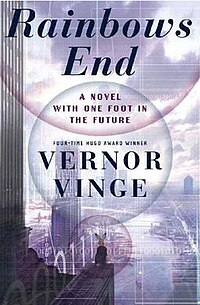
The 2 books in question are The Wise Man's Fear by Patrick Rothfuss and Rainbow's End by Vernor Vinge. The first is book 2 in the Kingkiller Chronicle fantasy series and the second is a Hugo Award winning science fiction novel. 
I'd actually begun reading The Wiseman's Fear right back at the beginning of February, whereas I didn't pick up Rainbow's End until later in that same month. I was keen to get into The Wise Man's Fear as I'd enjoyed The Name of the Wind (book 1 in the series). Reading Rainbow's End came about as it was mentioned by more than one person at #VALA2012 and #libcampoz12
.
Given it's not unusual for me to have a couple of books of variant genres on the go at the same time I was surprised that I found it so difficult to get into Rainbow's End. I must have read that first chapter about three times before finally I settled in and started moving along with the story. I realised I had to stop and adjust my reading style to suit the book I was reading, whilst still being flexible enough to continue reading the other books I had on the go, including The Wise Man's Fear.
.
For a while there I actually put both books aside and read nothing. I seemed unable to consider picking up a book, any book, and read. After a few weeks of picking up the occasional paperback whilst I ate lunch at work I found myself keenly anticipating reading more deeply. I had my reading mojo back!
.
I then started reading everything else I had on the go (other than Rainbow's End and The Wise Man's Fear) - I caught up on Labyrinth and Downpour from Kat Richardson's Greywalker series, started reading my way through Gabrielle Lord's Conspiracy 365 series (I'm up to October),  read Nicole Alexander's The Bark Cutters and A Changing Land (before handing them on to my daughter), finished off a handful of Mills & Boon Regency romances, and kept track of all my reading via Goodreads.
.
I felt reinvigorated. It's a great feeling.
.
Oddly enough it was after finishing off a late night session of back-to-back Regency romances that I picked up Rainbow's End. Throughout my hiatus I had been thinking about the two storylines that I wasn't reading, wondering what was happening with the characters, considering what I had learned about them so far. I am innately curious and I found my curiosity providing much of the impetus for the return of my reading mojo.
.
And so I read. I poured over the pages of Rainbow's End and when I read that last paragraph (twice, just to make sure I had actually reached the end of the story and there was no more left to learn) I closed the book and thoughtfully put it aside. I sat there a while and considered why I had started reading it in the first place and realised along the way I had become so caught up in the characters that I had forgotten that. I looked back on how I felt about the descriptions of this futuristic library and its simultaneous destruction and digital retention and realised that this world it described is not so strange. The sheer possibility of this world is staggering. Target achieved.
.
.
I can't tell you about The Wise Man's Fear - I haven't finished it yet. It currently has the single pleasure of joining me for breakfast each morning (one sure way to ensure I actually stop long enough to eat something substantial before the day begins in earnest). 
.
I am certainly profoundly grateful that I learned to slow down a little and give each book its own time. I am thoroughly enjoying taking each precious moment with these books so that they don't become a blur, but a profound experience. I have learned to take my speed-reading skills and commitment and apply it to spearing each word on the page and giving it due consideration.
.
What more can I say? I love reading. :)